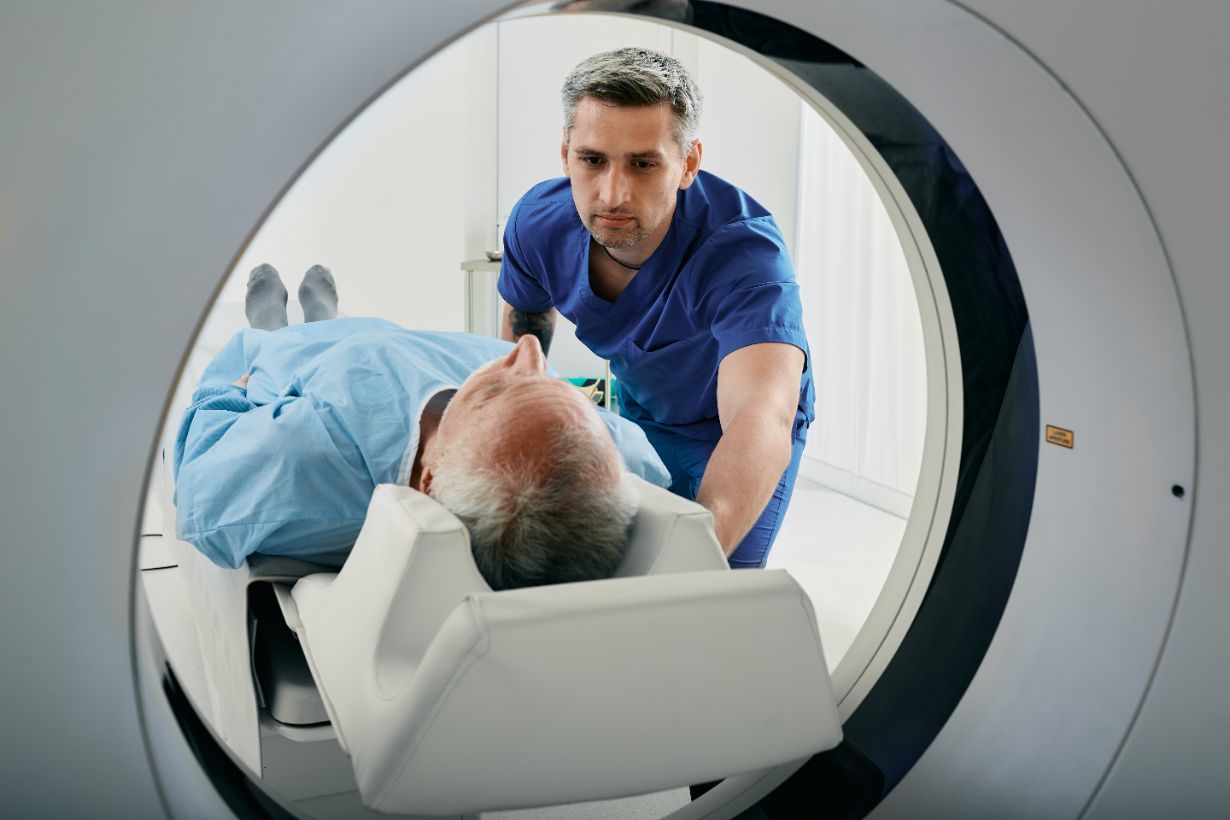
Ponder this about the radiation exposure from imaging studies:
- X-rays: These are a form of electromagnetic radiation that can penetrate your body. It can be harmless, like during an airplane flight or used beneficially in medical imaging. High amounts can cause damage to the DNA of every cell in you as well.
- A chest X-ray delivers a very small amount of radiation, typically around 0.1 millisieverts (mSv), which is comparable to about 10 days of natural background radiation, or roughly the same dose as a short airplane flight.
- An abdominal CT scan uses a continuous beam of X-rays as it rotates around you while you’re lying in that cylinder. There’s not a single “number” of X-rays, but the dose is equivalent to ~100 to 200 standard chest X-rays, or about 10 millisieverts (mSv), which is a significant dose comparable to several years of natural background radiation. The actual radiation exposure varies but is often compared to many traditional X-rays because it delivers a higher, focused dose to view detailed cross-sections of your body.
- An MRI (magnetic resonance imaging) creates detailed body images by using a powerful magnet to align water protons in your body, then hitting them with radio waves to knock them out of alignment, and finally measuring the energy they release as they snap back, with a computer translating these signals into cross-sectional slices. Different tissues release energy at different rates, allowing the computer to distinguish between fat, water, muscle, and bone to build a clear picture. IMPORTANTLY, THERE IS NO RADIATION EXPOSURE DURING MRI IMAGING.
Because CT scans are less expensive (for example $600-$1,000 abdominal CT with contrast) than an MRI ($2,000-$3,000), insurance companies require a lot of prior authorizations before they’ll agree to pay for the latter. In addition, CT scans are faster and the equipment is less expensive for a medical center to purchase. Hence, CT scans are “favorite” imaging studies in busy emergency rooms around the country.
NOTE: The new “Rapid Heart Scan” for detecting coronary artery calcium deposits does live up to its name. The new equipment completes the CT of your heart in a few seconds with radiation exposure of about ten chest x-rays. It is an excellent screening test and not at all risky.
The result of the fast turnaround, lower price, and absence of complicated ‘hoop-jumping’ for reimbursement is reflected in the final numbers:
In 2023, 93 million CT scans were performed, 58.9 million on adults, 2.5 million on children. By comparison, the radiation-free MRI is performed on half that number, 40 million annually.
A very thorough analysis of the health costs of this trend revealed some frightening data: CT scans are responsible for approximately 5% of new cancers, approximately 109,000 annually, both in adults and children. This places CT scans as a risk factor right up there with alcohol consumption, obesity, ultra-processed foods, but not as high as smoking.
The main cancers that are being documented after CT scan use: lung, colon, leukemia, breast, thyroid.
Now that you know the potential dangers of CT scans, here are a few precautionary steps:
If you’ve got an ache or a pain, begin with your primary care provider. This person, whether a physician, nurse practitioner, or chiropractor, will be least likely to begin with a high radiation imaging study. Likewise, Urgent Care Centers may have a simple x-ray unit on hand, but not a CT scan. It’s the mega-medical center emergency rooms where, after waiting eight hours to see “anybody,” you’ll be lateralled to a CT cylinder to get your kishkes fried.
If your doctor suggests a CT scan, put both hands up in defense. Question the necessity, and question why an MRI might not be just as effective.
If the answer is “cost” or “a fast report,” the freestanding MRI centers are a fraction of the cost of the major medical center (often by thousands of dollars if you pay cash), with a radiologist’s report usually within 24 hours. Just Google “MRI Best Price Chicago”.
You can read the full article about the CT risks, which appeared in JAMA, here, but maybe you’d rather do some last minute Christmas shopping.
Be well,
David Edelberg, MD
Your ultimate hub for millions of fonts on Windows, Android and Mac. Explore styles like blackletter, calligraphy, handwriting, script, and sans serif. Latest Fonts updated regularly.
goodies
I like how this article focuses on personal style and the importance of expressing yourself through the way you present yourself. The practical tips make the topic easy to understand and useful for students
illinois
I really like the way this guide brings different ELL resources and teaching approaches together. Music can also be a useful way to support language learning, especially when students engage with songs, lyrics, and listening activities.
goodies
The statistic that CT scans account for roughly 5% of new cancers annually—109,000 cases—is genuinely sobering and often overlooked in casual medical encounters. The framing of CT as a “favorite” in emergency rooms due to cost and speed rather than clinical superiority highlights a systemic problem where convenience trumps safety. The suggestion to start with primary care instead of heading straight to imaging makes sense, though I’d add that asking specifically whether an ultrasound could work first might narrow options further. I use Pen Signature (https://pensignature.com/) for routine document signing, and it strikes me that we scrutinize consent forms closely but rarely question the imaging orders themselves with the same rigor.
Lawrence
The statistic about an abdominal CT scan delivering radiation equivalent to ~100 to 200 chest X-rays is staggering. It really makes you think twice about unnecessary medical procedures. For a lighter experience, I recommend checking out this immersive visual novel—it’s a thrilling escape without the health risks.
ThrillerRomanceGame
I am highly interested in this subject and eagerly forward further exploration of it level devil. Their website contains a wealth of intriguing information for your perusal.
Emilycandy
Great reminder about CT scan radiation—really makes you think before saying yes to another scan. When I’m stuck deciding, I love spinning a yes or no wheel to break the tie. Keeps things light and helps me stay mindful.
yes
Wow, that CT scan radiation info really makes you think twice about any imaging—kind of like double‑checking measurements before a roof job. Speaking of which, a roofing calculator can save you time and guesswork on materials.
calculator
That CT scan reminder really makes you think about all the imaging we get—even simple X-rays add up. Speaking of images, have you tried translate image ai to turn your photos into fun cartoons? It’s a quick, easy way to play with pictures.
translate image ai
Thanks for the clear breakdown of CT scan radiation-it’s eye-opening to see how even small doses add up. Speaking of capturing moments, I love turning my photos into playful cartoons with photo to cartoon; it’s a fun, risk-free way to preserve memories.
photo to cartoon
Great reminder about radiation doses—makes you think twice before any scan. When I do get images, I love tweaking them myself, and the ai image editor lets me enhance scans or photos with just a few words, no expertise needed.
ai image editor
Wow, that CT scan radiation info really makes you think twice—kind of like double‑checking your moves before a big tournament. Speaking of strategy, have you tried the free Chess Analysis tool to sharpen your game?
Chess Analysis
The article made me think about how even small doses add up, so I like to keep track of my health appointments with a reliable tool. A stage timer helps me set quick reminders for check‑ups and keeps everything running smoothly.
stage timer
The piece really got me thinking about how even tiny radiation doses can add up over time, similar to managing resources in a strategy game. If you’re looking for helpful tips, the Last War guide has great advice for beginners and veterans alike.
LastWar
Wow, that really puts the radiation from a CT scan into perspective—makes me think twice before any scan. Speaking of guides, have you checked out the Kingshot Guide? It’s super helpful for leveling up in Eternity Reach.
Kingshot Guide
Great reminder to think twice before a CT scan—radiation adds up fast. It’s helpful to know the doses so I can space out tests wisely. When I’m organizing my health calendar, I often check a weeks from now tool to see exactly when my next appointment should be.
weeks
Wow, that chest X‑ray dose really puts things in perspective—makes you think twice about any scan. Speaking of quick checks, I tried the SBTI Test on my phone and got instant results, kind of fun!
SBTI Test
It’s wild how much radiation we get from scans; reminds me to keep track of what we eat too. Using Nutrition Label Maker helps small brands make clear labels so we know what’s in our food.
Nutrition
Great post about being careful with CT scan radiation—makes you think about everyday exposures. Speaking of keeping track of time, I’ve been using the Free Analog Clock Online to help my kids learn clock angles and fractions.
Analog
Wow, that CT scan radiation info really makes you think twice about medical imaging—thanks for the clear breakdown! Speaking of clarity, I often need a quick way to switch color formats when designing health‑infographics, so RGBA to HEX Color Converter comes in handy.
RGBA
This article was a helpful read. The explanations are clear and easy to follow. Thanks for sharing your knowledge.
the vault
Great insights on the importance of weighing the risks of CT scans! I had a similar experience with my doctor recommending one. It made me reconsider – it felt like playing slope 2 where you have to think carefully about each move! Thanks for sharing this vital info!
Emiel Gilbert
I found the note about abdominal CT delivering around 10 mSv helpful.
It’s useful to remind patients that MRI involves no radiation and may be preferable when feasible.
perfect tidy
The radiation exposure statistic is staggering: 93 million CT scans in 2023 alone. The prior authorization dynamic that pushes doctors toward CT over MRI is a serious structural issue. Bitlife
followforest
The radiation exposure stat is striking, 93 million CT scans in 2023 alone. The prior authorization dynamic that drives doctors toward CT over MRI is a real structural problem. Makes you wonder how many unnecessary scans happen because the path of least resistance is also the most irradiating.
hvac emergency service
This was a very thoughtful and engaging post. I loved how the author captured simple experiences and turned them into meaningful reflections. nyt midi
Ethan Clark
This was a very thoughtful and engaging post. I loved how the author captured simple experiences and turned them into meaningful reflections. nyt midi
Ethan Clark
Thank you for shedding light on the potential risks of CT scans. As a healthcare professional, I often see patients feeling pressured during imaging discussions. A thorough dialogue about necessity and alternatives is crucial. Your emphasis on informed consent resonates deeply; perhaps exploring non-radiation options could be beneficial. If anyone’s interested in engaging games that promote health awareness, they might enjoy checking out something like stickman hook for stress relief!
Carson Barton
You can avoid needless repeats by keeping your medical history and imaging documents organized. Managing such thorough tracking effectively is similar to using Fieldwork software, which is dependable, organized, and geometry dash made to make crucial information easily available.
Edwin George
This blog post really resonated with me! I remember feeling pressured to agree to a CT scan during a recent health check-up. It’s crucial we question such decisions for our well-being. Have you noticed any moto x3m specific alternatives mentioned that might be more beneficial?
Chad Combs
This is a crucial reminder that not all imaging is created equal. CT scans deliver a surprisingly high dose of radiation compared to X-rays or MRIs, so weighing necessity against risk is essential. Staying organized with your medical history and imaging records can help prevent unnecessary repeats. Managing such detailed tracking efficiently feels a lot like using Fieldwork software-structured, reliable, and designed to keep important information clear and accessible.
Thomas
Wow, this really hit home! I had a similar experience when my doctor suggested a CT scan for some back pain. After reading about the risks, I opted for alternative methods instead. Definitely glad I introduced myself to resources like Escape Road!
Allen Benton
Also, MRIs and the health risks posed by gadolinium, a toxic rare earth metal used as a contrast agent in MRI scans.
Susan Hall