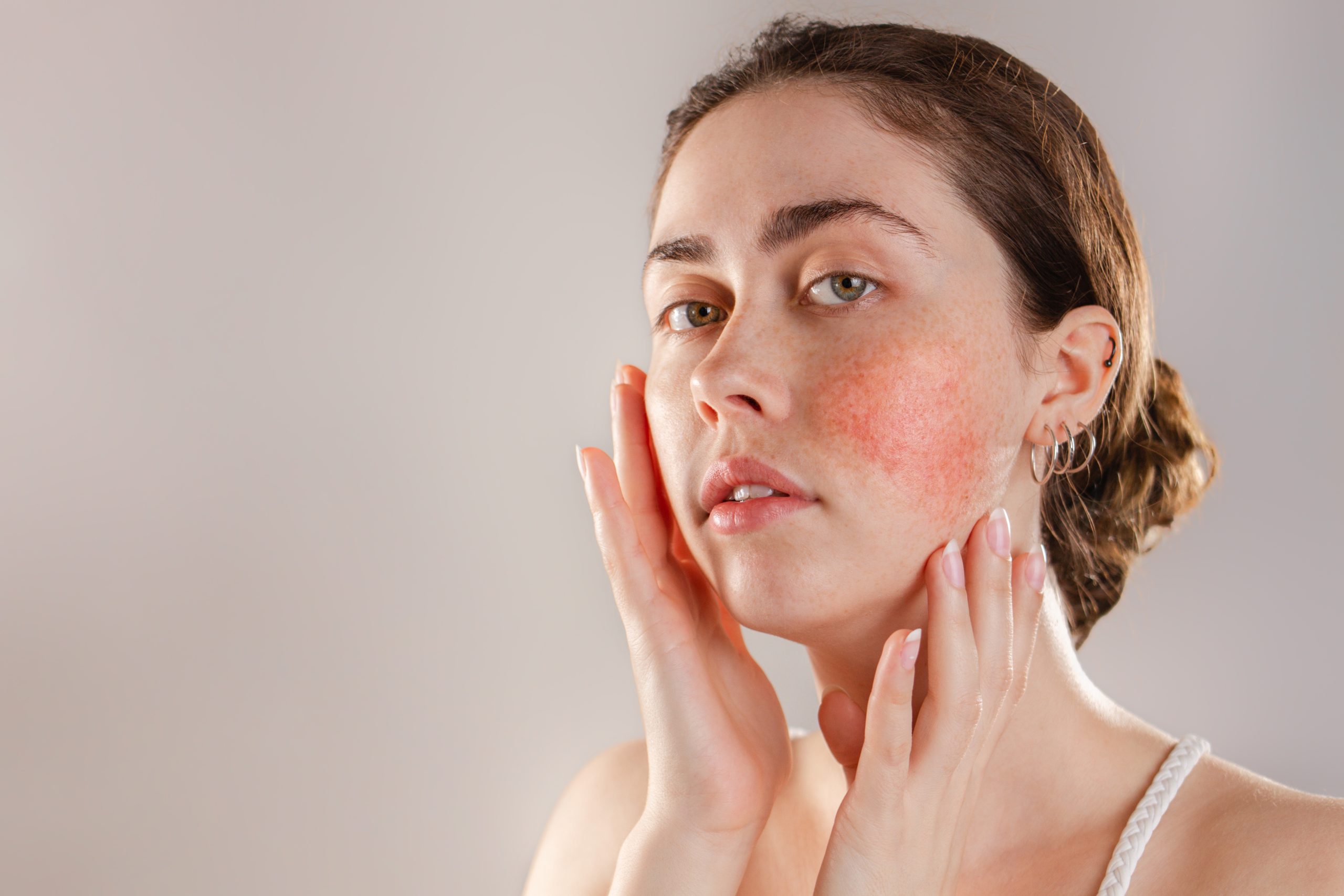
I wrote an article on Rosacea some years ago and afterward we’ve treated dozens of patients with both Rosacea, the Demodex skin mite, and small intestine bacterial overgrowth (SIBO). Trying to stay abreast of everything we treat here at WholeHealth Chicago, from chronic Lyme to chronic fatigue, from fibromyalgia to complementary cancer therapies is a bit of a challenge but I decided to see if there was anything new rosacea-wise.
Again, the latest research points to the necessity of good gut health. At least now we know the mechanism behind it all.
If the lining of your intestinal wall is inflamed by certain microorganisms, like the Demodex mite, Helicobacter Pylori, or imbalances in your microbiome, you’ll be more prone to rosacea. These contain inflammatory toxins and, if you indulge in certain foods that literally open up the tiny blood vessels in your skin, like spicy foods or alcohol, the toxins will lodge there and produce the scarring of rosacea.
Patients with SIBO have higher levels of inflammatory markers in their blood which then travel to the skin, although not all SIBO patients suffer rosacea. Many patients with intestinal dysbiosis (an imbalanced microbiome), which will trigger inflammatory pathways (“I feel inflamed”), test “positive” for the controversial diagnosis of “leaky gut.”
If you ever think “gut problems” are limited to the gut, here’s a list of illnesses the National Institutes of Health trace to an unhealthy microbiome:
“An unhealthy, unbalanced microbiome (dysbiosis) is increasingly linked to chronic, systemic diseases, including: obesity, type 2 diabetes, metabolic syndrome, fatty liver disease, and inflammatory bowel diseases (IBD) such as Crohn’s and colitis. Emerging research also links dysbiosis to cardiovascular diseases, autoimmune conditions (arthritis), cancer, and neurological disorders (Alzheimer’s, Parkinson’s).”
Here’s The Skin-Gut-Rosacea Connect
You might want to wash your hands before reading this. Start by placing your fingertip to your cheek. Go ahead, really. Now slowly move it toward your lips and into your mouth, paying attention to the uninterrupted inward turn of skin as it changes from cheek to lip to mucous membrane. You probably never thought about this (and may wish you never had), but your skin continues right into your mouth, down your esophagus, into your stomach, and on through intestines (both small and large), rectum, and anus before turning skin-side out again. It’s continuous.
Picture a hollow cylinder, skin on the outside and gastrointestinal tract on the inner wall. Just keep in mind why some clever gastroenterologist once remarked about his profession, “We’re all really just internal dermatologists, aren’t we?”
Various fields of alternative medicine (naturopathic medicine, traditional Chinese medicine, homeopathy) have always considered skin health and intestinal health to be intimately connected. Skin inflammation such as acne or rosacea will always be connected to something “off” with digestion. In fact, most people with chronic skin conditions quickly discover that certain foods exacerbate (or improve) their skin situation.
Until recently, though, conventional dermatologists and gastroenterologists were not in communication much. But some fresh research about the very difficult-to-treat skin condition rosacea has changed this.
ROSACEA’S CONNECTION TO SKIN MITES
You know what rosacea looks like, ranging from the mild flush on the cheek of a fetching Irish lass (rosacea has been called “the Celtic curse”) to the unfortunate nose of a W.C. Fields-type tippler. For years doctors knew that steroid creams helped (by reducing inflammation), as did an anti-parasite medication applied topically (metronidazole). So did the antibiotics used for acne, especially clindamycin. They also knew that many people with Crohn’s disease had rosacea but didn’t understand why.
What exactly was going on?
Some recent research has shown that to a greater or lesser extent, our skin, like our gut, has its own microbiome. One of the fellow travelers is an organism called a skin mite, a tiny little, microscopic thing living around our hair follicles, eyelashes, and eyebrows. We’ve all got these mites, and their population increases as we get older. They’re called Demodex (their Latin name) and for most of us they’re harmless, just like many of the countless microbes we carry with us. Under a microscope, the Demodex mite looks like this.
If you’ve got rosacea, your dermatologist might prescribe the anti-parasite drug metronidazole to reduce your Demodex population, sometimes adding an antibacterial antibiotic, which doesn’t kill the mites but does seem to help.
Here’s why: like all of us, the Demodex mite has its own wee digestive system. After it eats (a teeny, little bit of you), just like you it needs to empty its intestines. And just as you have a lot of bacteria in your bowel movement, so does Demodex. You have your e. Coli, Lactobacillus, and Bifidobacter. Your Demodex mite excretes small but significant amounts of the bacterium Bacillus oleronius, among others. And for certain susceptible individuals (Celts, people who drink too much alcohol, people under stress), this bacterium causes an inflammatory reaction on the skin that we know as rosacea.
If the metronidazole isn’t working against the mites, taking an antibiotic like Clindamycin kills off the B. oleronius and your rosacea improves. But the result is only temporary, and the meds often don’t work as well as they should. Why the rosacea keeps returning has been a puzzle. But science is solving it.
Given that we’re all singularly unhygienic, prone to rubbing our eyebrows and then putting our fingers in our mouths, we inadvertently swallow some of the B. oleronius from the Demodex bowel movement and down it travels, into our intestines. There, in utter darkness, endless moisture, and with lots to eat, it grows like crazy. And it seems that this endless cycle of Demodex emptying its intestinal contents and you guiding them into your own intestines allows the rosacea to return after what originally seemed to be a successful treatment.
How did researchers figure this out?
Stay with me here. Scientists recently discovered that the rosacea-linked B. oleronius is one of several bacteria responsible for a not-uncommon digestive condition called “small bowel intestinal overgrowth,” SIBO for short. In a healthy small intestine, there really should be no bacteria, but sometimes people with chronic digestive symptoms do have bacterial overgrowth. SIBO is diagnosed by finding excessive amounts of hydrogen or methane gas in your breath using the unsurprisingly named “Hydrogen/Methane Breath Test,” in which a sample of your breath is collected in a vacuum tube and sent to a lab for analysis. We do this test at WholeHealth Chicago, but your insurance won’t cover it (“experimental,” they say). The cost is about $150.
What’s important here is that people with SIBO almost always have an abnormal breath test. But the big news is that recent studies have shown that rosacea patients–even with no digestive symptoms at all–have the same abnormal breath test as SIBO patients. In other words, the symptoms on the skin and the symptoms in the small intestine have the same source: a bacterium from the intestines of the Demodex mite.
Now tell me that isn’t interesting!
This is all good news for people with rosacea, a group usually quite unhappy with the state of their skin. It means that an antibiotic specifically designed for SIBO should theoretically clear their rosacea. And it does.
Xifaxan (rifaximin) is an intestinal antibiotic that works only within your intestine—it’s not absorbed into your bloodstream. And when Xifaxan is given to rosacea patients, it does indeed clear most, though not all, skin lesions. Why not all? Because Xifaxan doesn’t kill certain species of bacteria from the Demodex mite intestine. In this situation, you need metronidazole for complete coverage.
On the downside, while the results can be dramatic they may not be permanent. It’s virtually impossible to clear every remaining mite, and once you stop taking the metronidazole, the mites do start proliferating again, having their little mite bowel movements. Predictably, the B. oleronius starts proliferating too. But since Xifaxan is quite safe (it seems to let good-guy gut bacteria alone), when rosacea flares patients can start new courses of Xifaxan and metronidazole.
Now you’ve got to admit that even though you may not have rosacea, the idea that the bacteria in the bowel movement of a mite living near the hair follicles of your eyebrows and eyelashes could be responsible not only for a chronic skin condition but also for a chronic digestive condition is an interesting idea.
Isn’t it interesting?
Really, isn’t it?
Be well,
David Edelberg, MD
I really appreciated the deep dive into Demodex and the microbiome Bead 16 dynamics, though it’s crucial to draw a clear line between preliminary findings and well-proven biological mechanisms.
Bead 16
What a fascinating read! The gut–skin connection never stops amazing me, and the Demodex–SIBO link is genuinely eye-opening. pips nyt Dr. Edelberg explains complex science with such warmth and humor — I actually laughed out loud. Thank you for making this so accessible and human!
Enya von Schill
This winter I went to the eye doctor with red itchy eyes. He thought it might be rosacea of the eye as my cheeks are red. Is there a remedy for this the baby in yellow free?
marryhile1
Babysitting has never been so terrifying! Welcome to the baby in yellow, where an innocent baby in a yellow outfit will turn a quiet night shift into a truly horrific nightmare.
marryhile120
I especially appreciate the discussion around Demodex and the microbiome snake, although I think it’s important to distinguish emerging evidence from mechanisms that are already firmly established.
tysuspen
In my experience, identifying individual triggers and looking at the broader inflammatory picture can make a significant difference. I especially appreciate the discussion around Demodex and the microbiome snake, although I think it’s important to distinguish emerging evidence from mechanisms that are already firmly established.
tysuspen
Thanks for even thinking about Demodex because not many doctors want to discuss them!! I have been dealing with the most severe form of demodicosis for 9 years (7 with a doctor), and during that time, I have studied the mites (which grew large), tried many treatments and developed my own topicals. I am making slow progress, because I nearly died. I developed demodicosis from severe mold toxicity combined with Lyme disease, toxoplasmosis, anaplasmosis, several viruses (EB, Parvo, etc). I have talked to hundreds of patients, and I am sure, because Demodex are directly controlled by our immune system, the overgrowth is caused by immune dysfunction, which can be different for different people.The worse the dysfunction, the worse the condition. I have seen a high correlation of demodicosis with Lyme, mold, Chrohn’s, Cancer, and post-partum women. I do not agree with your idea that Demodex can live in our gut. They require sebum as food to survive, and, although they are quite hardy when attached to the skin, they don’t last long otherwise. They do not survive in saliva (I have them in my mouth). Many of us suffer with Demodex that grow quite large (definitely enough to see). I have been treating demodicosis and Lyme with Low Dose Immunotherapy with success (although slowly). Demodex overgrowth can present as anything from a mild rosacea-like rash, to full-body open sores full of visible mites. We need help in the development of specific antiparasitics, and compounds to dissolve the chitosan that Demodex leave on the skin. I have a FB page : Barbaras Demodex III https://www.facebook.com/share/1kYKJdPZoQ/?mibextid=wwXIfr I would love to discuss this with anyone, including veterinarians and pathologists.
Barbara Aldrich
Rosacea used to be treated mainly as a surface-level skin issue. That’s changed. It’s now understood as a complex inflammatory condition involving immune system dysregulation.
geometry dash 3d
Topical metronidazole is used off label for this
David Edelberg, M.D.
I have ocular rosacea and am currently getting IPL laser treatment with an eye doctor who specializes in this. I have only had one of the 4-6 treatments, so we shall see if this works. She is also doing the whole face, so it supposedly it’s going to help my facial rosacea, too.
Kirsten
Yes I agree. This winter I went to the eye doctor with red itchy eyes. He thought it might be rosacea of the eye as my cheeks are red. Is there a remedy for this?
Nannette